Webinar Recap: Lessons from the Front Lines: How Fleets Are Integrating EVs
Summary
Fleet leaders at Modo and the County of Ventura shared practical steps for expanding EV programs in shared and government fleets. Their recommendations include using short video tutorials for users, establishing charging infrastructure before purchasing vehicles, and managing different charging standards with smart adapters. Their experience shows that careful planning is essential for successful EV integration.
Did you miss the live session? Watch the full webinar to revisit the discussion.
What works best when educating users?

For fleets introducing EVs to shared environments, user education quickly becomes operational risk management. At Modo, where more than 200 EVs span multiple models, even small differences between vehicles created confusion: charging ports in different locations, varying plug types, and different unlocking steps.
For members unfamiliar with EVs, especially first-time drivers or those facing language barriers, written instructions did not solve the problem.
Erin Sullivan, Director of Operations of Modo Carsharing Co-op, shared that they began with FAQs, printed materials, and events, but the breakthrough was embedding short, model-specific YouTube videos into the booking flow. Before a trip, members watch a video showing how to handle charging for their vehicle. The lesson: simple, direct instruction works best.
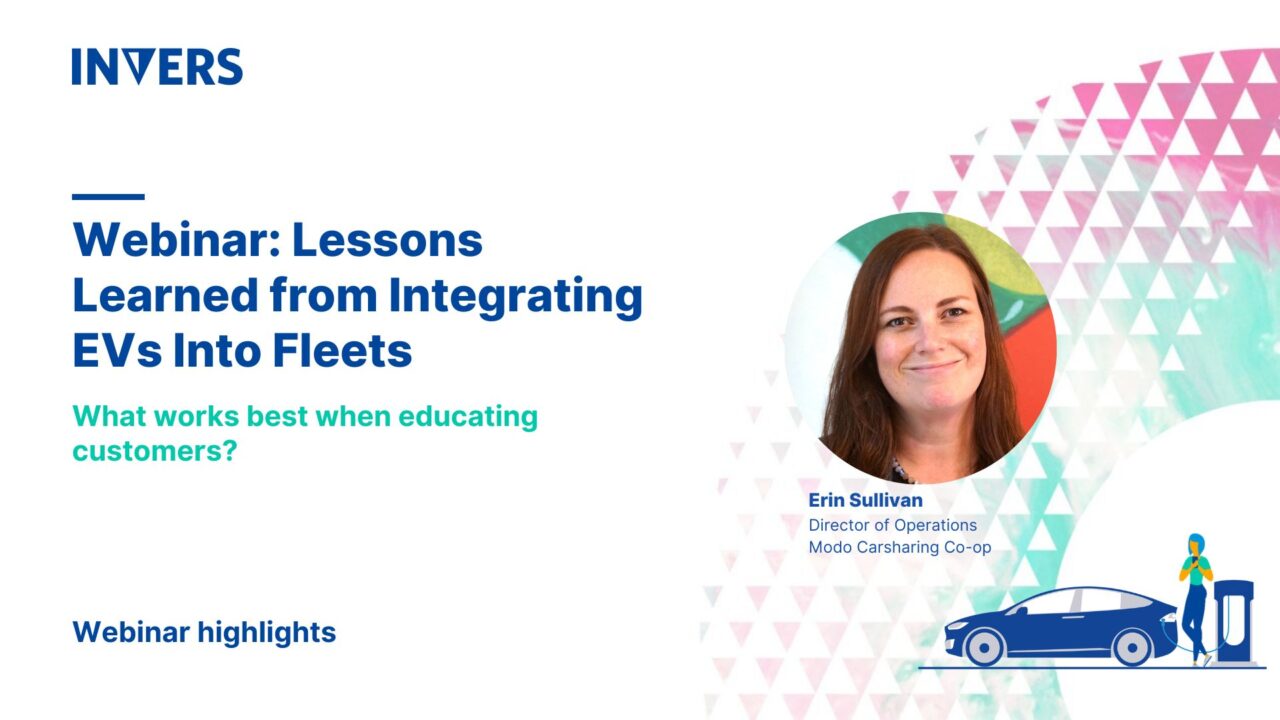
“Video is the best way,” Erin said. “Many members are new to Canada or are visual learners. Just show me on my phone in a minute, and I’ll get it.”
The results were immediate: support questions dropped, user confidence improved, and feedback was positive. Physical in-car materials still help, but Modo is moving to QR codes linked to the same videos. This approach lets the team update content remotely across the fleet, without site visits.
The lesson is clear: shared mobility education should be visual, immediate, and tailored to the specific vehicle. This ensures users know how things work before arrival, reducing operational friction and streamlining processes.
Why must charging infrastructure come before the vehicles?
Without a reliable charging infrastructure, EVs become parked assets instead of operational vehicles.
Robert Crawford, Administrative Manager of Fleet Services at the County of Ventura, put it plainly: a fleet can secure funding and take delivery of electric vehicles, but if there isn’t dependable charging infrastructure ready to support them, those vehicles risk sitting idle.
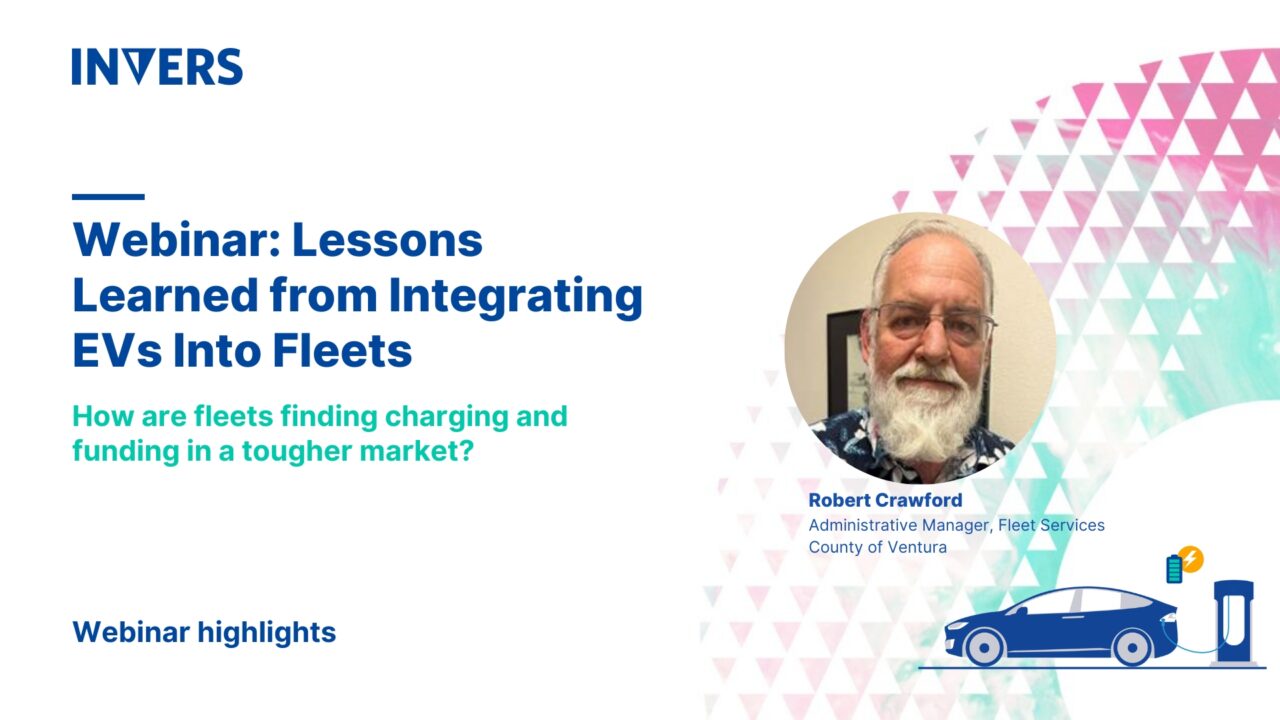
“As a fleet department, I’ve got the capital to buy any vehicle I want at any time,” Robert explained. “But if I don’t have a place to plug it in, I really don’t want to have substantial capital just sitting in the parking lot waiting.”
The County of Ventura took a deliberate, multi-step approach to infrastructure. A key move was partnering with Southern California Edison through the Charge Ready program. In exchange for a ten-year property easement and usage data, Edison handled the full underground infrastructure build, including transformers, breakers, meters, and trenching, at no cost to the county. This turned a major capital expense into a structured long-term commitment.

The County of Ventura also added solar-powered off-grid charging at remote leased sites where trenching was not possible. State grants and California Energy Commission funding supported these installations. As grants become harder to secure, the county now employs a full-time sustainability administrator to track grants and manage funding strategy. Robert considers this role essential.
His practical guidance for operators navigating a more competitive funding landscape: build peer networks. Through the Central Coast Fleet Association, fleet leaders meet quarterly to share what’s working, what isn’t, and where funding opportunities exist.
For car sharing operators, equivalent industry networks serve the same strategic purpose.
Modo operates in dense urban neighborhoods with shared parking and limited charger availability, but reached the same conclusion. Whether through developer partnerships, curbside dual-port charging, Level 1 solutions, or vehicle-swapping models, the principle is the same: charging access determines fleet viability. Vehicles can be added quickly. Infrastructure takes longer.
Takeaway: Infrastructure is the critical foundation for any EV fleet. Charging access must be prioritized before vehicle acquisition for program success.
How should EV fleets handle mixed charging standards?
Fleets should focus less on plug types and more on the overall charging strategy.
As NACS becomes the standard, some operators worry that CCS vehicles will become obsolete. Charging standards are evolving, but Kapil Shah, Data Analytics and Auto Industry Analysis at AutoMobility Advisors, stresses the transition is gradual and manageable despite uneven infrastructure.

For fleets, the main operational question is not which plug type will win. It is whether there is a clear adapter strategy, proper driver education, and a defined charging policy. NACS became the standard mainly because Tesla’s Supercharger network is large and well distributed, covering major cities and connecting regions in ways CCS has not.
Kapil estimates it will take 5 to 10 years for NACS to fully replace CCS in available infrastructure.
This transition period is manageable and may offer advantages. As more consumers choose NACS-equipped vehicles, CCS models could become more affordable on the secondary market. Fleet operators with the right adapter strategy can benefit from lower costs without losing usability.
The key is to know which adapters your vehicles need and include them as standard equipment in the fleet.
Erin Sullivan offered a real-world example of this transition in action. Rather than waiting for infrastructure alignment, her team created 3D-printed adapter brackets so members always have what they need to plug in. It’s practical. It’s hands-on. And it works.
Takeaway: Mixed charging standards are manageable when fleets have the right adapters, processes, and training to ensure smooth operation and lower costs.
What metrics do EV fleets need to track?
At a minimum, fleets should track state of charge, plug-in status, and charging progress.
Managing EVs requires different data than managing combustion vehicles. Chris Anderson, INVERS Sales Director, says key EV fleet data are whether the vehicle is plugged in, charging, and its current charge level. In shared fleets, these determine if a vehicle is available or offline.

“Knowing that the vehicle is plugged in, knowing that it is charging, and knowing what the current charge status is — those are the big differences for EV,” Chris noted.
A vehicle returned at 7% charge and left unplugged is not just a poor user experience. It takes the vehicle out of service. End-of-trip charge visibility on the platform lets operators act before a low-charge vehicle results in a missed booking.
On the hardware side, EVs have simplified some aspects of telematics installation. Most modern EVs use push-button start, so complex direct wiring is less important. Key fob integration with OBD or CAN bus connectivity provides access control and data, often with a simpler installation than many older ICE vehicles.
EV fleet management isn’t just about new vehicles; it requires updated metrics, timing, and response processes.
The bigger picture
Success depends on the system built around the vehicle, not the vehicle itself. For those looking to go further, the full webinar recording includes additional discussion on EV maintenance realities such as what operators are spending versus industry benchmarks, and where the real surprises tend to show up.
Kapil Shah of AutoMobility Advisors also published the Smarter Shared Fleets: 10 EVs Built for Carsharing guide offering a more detailed look into the operational framework for EV selection and deployment. You can get a free copy here: https://www.automobilityadvisors.com/product/ama-white-papers-reports-2026/
Related Posts

Car Sharing, Expert Interviews
Car Sharing & Public Transport: Teaming Up for Urban Mobility
We talked to Gunnar Nehrke, the managing director of the German Car Sharing Association, about Car Sharing & Public Transport. Learn how working together can create a convenient, affordable, and climate-friendly alternative to private car ownership.

Car Sharing
Car sharing & public transport: Examples of public transport running car sharing
Car sharing and public transport are often seen as competitors, but they are closely connected and can team up sustainable mobility. Here are 6 examples of public transport operator running their own car sharing service.

Car Sharing, Expert Interviews
Digitizing the Taxi Business – Lessons from GoodMoovs
We talked to Didier Bollen from GoodMoovs about their initiative of digitizing the taxi business. Explore how car sharing telematics help taxi operators to build a shared taxi fleet and improve fleet utilization.