Mobility’s Perspective on Cooperatives, Microcars and Transit

Summary
We spoke to Corinne Vogel, CEO of Mobility, about her experiences with station-based car sharing in Switzerland. She provided valuable insights into topics such as co-operatives, microcars, synergies between car sharing and public transport, factors for the ideal car sharing parking space, and services for business customers. The Swiss cooperative offers its nearly 300,000 customers 3,500 vehicles at 1,800 locations. Already 20 percent of the vehicles are electric cars. According to Mobility, one of its cars replaces 18 private cars, saving space, reducing traffic and protecting the environment.
The European car sharing market is complex, featuring a diverse range of business models implemented on the streets. Operators employ various strategies, such as station-based services, peer-to-peer car sharing, and free-floating services, to address distinct use cases and offer distinct services. In addition, the European car sharing market is one of the largest and the most complex in the world. To address and explain some of these complexities, INVERS publishes their INVERS Mobility Barometer on “European Car Sharing 2026”. This 70+ page report helps car sharing operators quickly understand key market dynamics, insights, and trends.
Table of Contents
As a key global car sharing cooperative, could you share your impressions of the annual meetings and regular work of the cooperative?
Cooperatives can provide a solution to current challenges. But they don’t come to life on their own. Mobility is organised into 19 geographical sections across Switzerland. All members of the cooperative are welcome to attend their respective branch meetings. There, they gain an insight into the company and elect delegates and alternate delegates every two years.
The delegates represent the members at the annual conference of delegates. At this meeting, for example, the annual and sustainability report and annual accounts are approved, decisions are taken on motions relating to the Articles of Association, and the Board of Directors is elected. Delegates may also submit motions and request written information from the administration.
Things get interesting when we move beyond traditional cooperative democracy. Mobility members, for example, take part in focus groups where they help to develop offers, present Mobility at local events and act as coaches on electric car training courses. This last example is a prime illustration of social support aimed at helping people to help themselves, which exists in this form only within cooperatives.
In what ways has the cooperative evolved and developed over time?
The Mobility Cooperative has been in existence for 30 years and now has over 76,000 members. As we grew, the question arose as to how our cooperative democracy would continue to develop so that it remains accessible without losing any of its substance. Digital formats are part of the answer. Voting and elections at the conference of delegates have been held digitally since 2020. Communication with delegates was stepped up via Microsoft Teams. And in future, members are to be involved even more closely. To this end, we are currently trialling a digital platform exclusively for members of the cooperative. Our aim with this is to make it even easier to connect with the community and encourage dialogue. After all, a modern cooperative must be able to do both: act professionally and quickly enough to survive in a dynamic market – whilst at the same time creating sufficient scope for members to have a say.
What criteria would you use to define the perfect Mobility car sharing parking space? How long does it take to turn an idea for a new station into a live parking space?
Our locations are at the heart of our car sharing offer, and as a tenant, we rely on suitable car parks. These must be accessible 24 hours a day, be of sufficient size and well-organised. Ideally, they should be located in densely populated neighbourhoods close to public transport. As our cars are unlocked via an app, it is important to have at least 4G coverage. If the parking space already has a charging point, that’s an advantage. After all, the number of electric cars in our fleet is rising steadily, and installing a charging point takes several months on average. By contrast, a location with a fossil-fuelled car is, on average, operational after four weeks.
What were the reasons for including microcars in your car sharing fleet? Can you already share first impressions from the Microlino pilot?
With this pilot scheme in the city of Zurich, Mobility aims to find out whether microcars meet a genuine need amongst its customers and whether they prove their worth in day-to-day car sharing. Our users often only need the car for a few hours and for short journeys.
The Microlino is therefore likely to be the ideal vehicle for many different applications. In any case, the microcars were used extensively during the first few months. Surveys show that many customers have made a booking out of curiosity. To find out more about microcars in the context of car sharing, the pilot scheme is being extended to further locations. We also continuously analyse users’ riding behaviour and collect feedback.
How do you leverage synergies with public transport operators such as SBB? Could you share data insights on the intersection between public transport and car sharing?
Car sharing is part of modern mobility and can only work in conjunction with a comprehensive and efficient public transport system. That is why Mobility maintains close ties with various providers and organises joint campaigns. Most important, however, is the seamless transition between the different modes of transport – that is, from the train to a shared car. Almost 1,200 of our vehicles are located right next to a railway station. That makes sense, as 92 percent of Mobility users have a public transport season ticket. Furthermore, surveys show that 15 percent of Mobility members use public transport more frequently after logging in for car sharing.
How do you serve businesses, and what makes companies choose Mobility’s car sharing offer over car rental, leasing or their own corporate fleets?
Over 6,000 companies, municipalities and property owners in Switzerland are already using Mobility instead of maintaining their own vehicle fleets. What sets us apart from rental or leasing is flexibility: Business customers have access to over 3,500 cars throughout Switzerland and pay only for the actual utilisation – with no capital outlay, no fixed costs and no need for their own car parks. Not only is this more environmentally friendly than maintaining a company’s own fleet, but it is also significantly cheaper. As every company has different needs, we provide bespoke advice and find the right solution – from flexible utilisation of the existing fleet to a dedicated Mobility location.
Further insights into the European car sharing market
Thank you, Corinne, for sharing your expert insights.
For more information and interesting findings about European car sharing, we encourage readers to check out our 70-page INVERS Mobility Barometer on “European Car Sharing 2026” with more expert interviews as well as insights from national car sharing associations. To discover more from Mobility, please visit their website.
Note: This interview has been originally conducted in English. On our blog, it is also available in German.
Related Posts
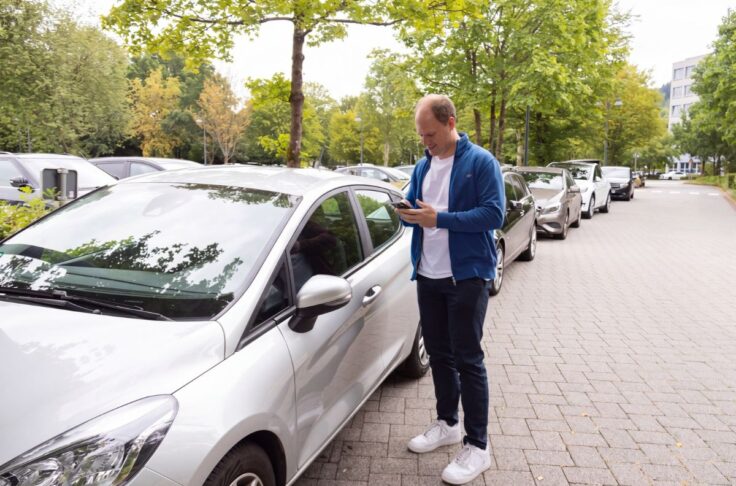
Car Sharing, Technology
Car Sharing Connectivity: What Happens to Your Fleet When a Mobile Network Fails
Nobody questions connectivity in car sharing until something is wrong. We take a look behind the scenes of two real network outages in Denmark and Latvia to show what happens to your fleet when a mobile network fails.
Car Sharing, Expert Interviews
MyWheels’ Perspective on Car Sharing Innovations like V2G & Driving Score
Claire Sipkema, COO of MyWheels, on her car sharing expertise in the Netherlands. She shared valuable insights on the vehicle-to-grid technology, anchoring car sharing into new housing projects, experiences with their driving score, their vehicle ambassador programme with so-called “sleutelfiguren”, and key factors for the success of Dutch car sharing.

Car Sharing, Expert Interviews
GoMore’s Perspective on P2P Car Sharing in Europe
We interviewed Thomas Christensen, COO of the GoMore Group, on his expertise in P2P car sharing. He shared valuable insights on, for example, learnings from running operations across 11 countries and different vehicle types on their platform.