

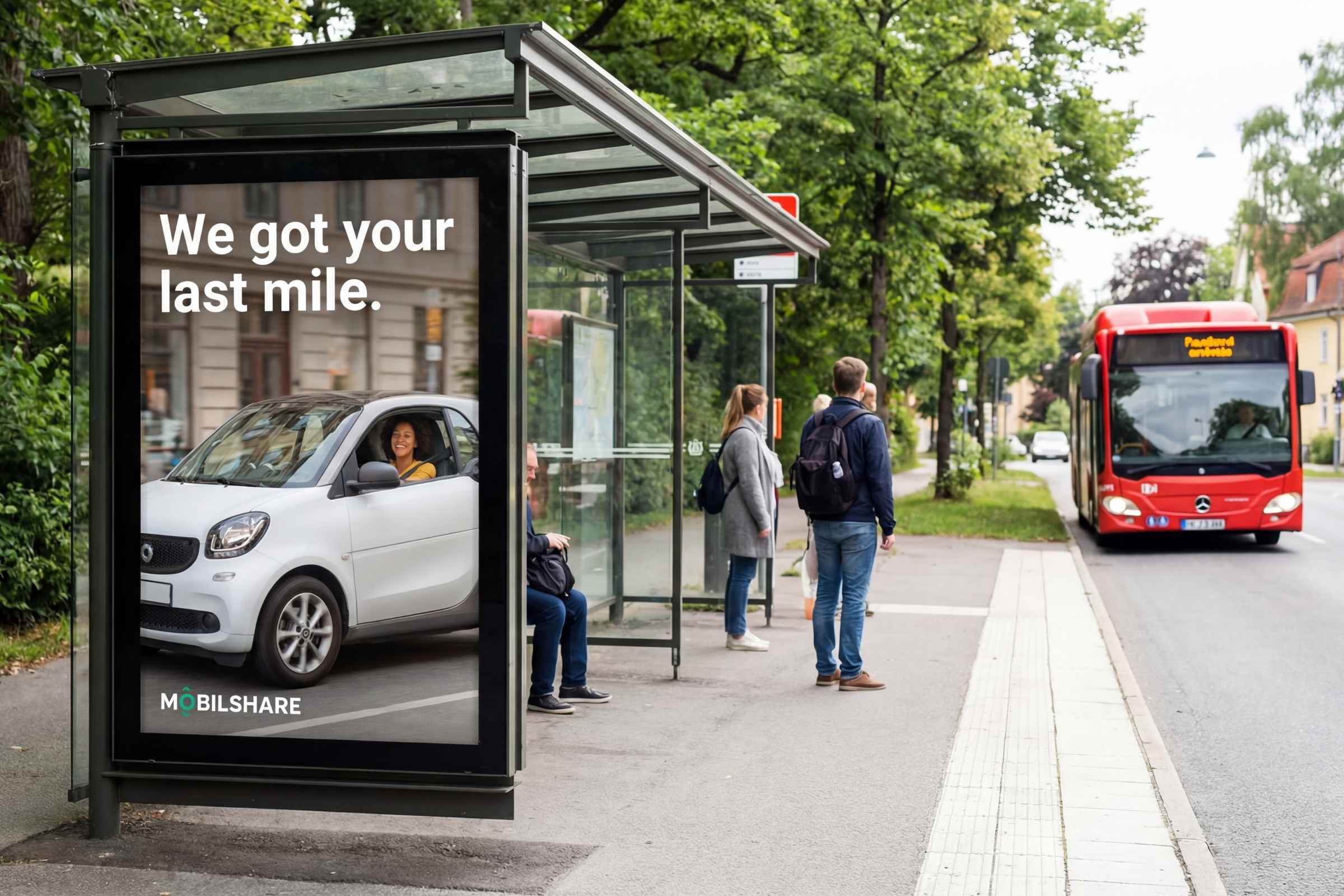
Your service is technically ready, but awareness is zero on launch day. That is the challenge most operators underestimate. The good news is that your most effective marketing tools are already sitting in your parking lot.
This lesson covers four marketing activities every car sharing operator should consider before and at launch: fleet branding, local partnerships, pre-launch campaigns, and promotional strategies for first-user acquisition. You'll learn how to use your vehicles as advertising infrastructure, which partnerships deliver the fastest returns, and which promotions convert browsers into regular users.
Brand Your Fleet
Your cars are moving advertisements. A single wrapped vehicle can generate up to tens of thousands of impressions per day in an urban environment, with no recurring cost after installation. For a larger fleet, that compounds rapidly.
Fleet consistency amplifies the effect. When every vehicle shares the same livery, color, and logo, each car reinforces every other. A user who sees your fleet on Monday, Tuesday, and Friday starts to form a mental map of your coverage area without any deliberate effort from you.
Keep the design simple: two to three contrasting colors, your brand name, and a website. Dense copy and multiple messages disappear at traffic speed. Work with a vehicle wrap specialist who can account for door seams, handles, and wheel wells, where vinyl will lift soonest.
Plan for refresh cycles. Wraps typically lose some of their attention-generating effect quite soon. Operators who maintain the strongest street presence treat fleet livery as infrastructure with a defined refresh schedule, not a one-time expense.
Build Partnerships Before You Open
Paid advertising can reach anyone. A partnership puts your service in front of people who already have a reason to use it. At launch, that distinction matters enormously for conversion.
Transit operators
Transit operators are the highest-leverage partnership for most urban operators. Public transit subscribers are already committed to sustainable, non-ownership mobility. Research across European operators shows that 70% of cambio users and 65% of Poppy users in Brussels hold public transport subscriptions. These are not occasional users. They are the profile of your most reliable customers. It also makes transit hubs some of the most effective advertising locations you can use. Placing ads at train station exits or platform areas puts your service in front of people at exactly the moment they are thinking about how to complete their journey.
Transit integrations take several forms: co-marketing, bundled subscriptions, station placement at transit hubs, or listing within a transit mobility app. Each reduces the cost and friction of reaching your core demographic.
Employers
Employers respond to a clear efficiency argument. A company mobility plan with dedicated business accounts and employee discounts converts a single partnership decision into a ready-made user cohort. The value proposition is concrete: corporate car sharing lets organizations reduce their owned fleet, cut maintenance costs, and still give employees reliable vehicle access.
Source: INVERS Success Story with Seattle City Light
Housing developers
Housing developers respond to a specific value proposition: a single shared car can replace up to thirteen privately owned vehicles in a residential development. That ratio directly supports developers pursuing sustainability certifications and reduces the parking infrastructure they need to build. An embedded car sharing service becomes a selling point for residents.
Source: Carré Mobility Uses INVERS Technology for Innovative Mobility in the Housing Industry
Formal strategic partnerships carry social proof that paid advertising cannot replicate. An official partnership with a city transit authority or employer signals reliability before a single campaign has run. That credibility compounds as your service becomes embedded in the local mobility infrastructure.
"The cooperation, especially with the city of Stuttgart, is excellent. This enables us to provide suitable public parking stations for our customers in Stuttgart's city center."

Hermann Trick
CEO | Stadtmobil Stuttgart
Source: Insights Interview on Station-Based Car Sharing with Stadtmobil Stuttgart
Run a Pre-Launch Campaign
A launch without a pre-launch campaign means arriving at go-live with cold traffic. These are people who have never heard of you, deciding in real time whether to try a new service. A pre-launch campaign reverses that dynamic. You arrive with a list of people who already signed up.
Start two to four months before your go-live date. The goal is to build a qualified lead base without losing momentum before the service is live.
Build a waitlist
A simple landing page with a clear value proposition and an email capture field is enough. Pair it with a referral mechanic. When a user refers a friend, both move up the launch queue. Position-based referral generates higher sharing rates than cash incentives because it creates personal urgency rather than a generic discount.
Run an invite-only pilot
Sixty to eighty percent off the first reservation, or a credit equivalent to a standard trip, reduces the perceived cost of trying to near zero. The first trip converts a registrant into a returning user, and car sharing revenue depends on that second and third booking.
Use founding member framing
Offer the first 500 or 1,000 registrations a permanent benefit. A discounted rate, bonus ride credits, or early access. This creates urgency among people who discover you during the waitlist period and rewards early commitment publicly.
Keep your list warm throughout the waitlist period with useful content: neighborhood spotlights showing where the service will run, use-case stories, and launch timeline updates. Operators who engaged waitlists this way consistently report stronger conversion at launch than those who let the list go dormant.
Offer the Right Promotions at Launch
Promotions for first-user acquisition can remove the barrier to the first trip. A user who has never tried car sharing is making a judgment call based on incomplete information. A low-risk first experience changes that calculation.
Free or discounted first rides
A substantial introductory discount (enough to make the first trip feel close to free) removes the perceived risk of trying a new service. Many operators offer 50–60% off the first reservation or an equivalent credit. The first trip is what converts a registrant into a returning user and recurring revenue.
Dual-sided referral programs
Run a referral program from launch day. Both the referring user and the new user receive a credit when a referral converts. This structure works because it aligns incentives on both sides: existing users have a concrete reason to share, and new users arrive with a reason to book immediately. Referral is consistently the lowest customer acquisition cost channel in mobility, and users acquired through referral retain at higher rates than those from paid channels.
Bonus zone promotions
Once you have operational data, offer additional credits for trips that start or end in specific areas. This lets you seed usage in underutilized parts of your service zone without reducing revenue across the board. It is also a practical tool for rebalancing fleet distribution without dispatching field staff.
Vehicle condition as a marketing decision
One point that sits outside any campaign budget. Vehicle cleanliness and damage transparency are marketing decisions. Negative word of mouth in car sharing reliably traces back to poor vehicle condition, opaque damage processes, or inadequate support at the first moment of friction. The welcome offer brings a user to their first trip. The vehicle they walk up to determines whether they book again.
Key Takeaways
Why should operators invest in fleet branding before other marketing channels?
Wrapped vehicles can generate up to tens of thousands of daily impressions with no recurring cost, and a consistent fleet design builds area-wide recognition simultaneously. It is your lowest cost-per-impression channel and works continuously without campaign management.
Which partnerships deliver the fastest return at launch?
Transit operator partnerships and employer deals tend to convert fastest. Transit subscribers are already habitual sustainable mobility users. Employer deals convert an entire population through a single agreement. Housing developer partnerships embed users with recurring local trips.
How early should I start marketing my new car sharing service?
Two to four months before go-live is a common practice. Start with a waitlist and referral mechanic, then run an invite-only pilot in the final weeks. Arrive at your public launch date with a qualified lead list, not cold traffic.
What promotion converts the most first-time users?
Free or heavily discounted first rides have the lowest barrier to trial. Dual-sided referral programs sustain acquisition past the launch period at the lowest ongoing cost per user. Run both from day one.
How does vehicle condition relate to marketing?
Poor vehicle condition and unclear damage processes are documented triggers for negative word of mouth in car sharing. A user's first trip shapes their decision to return. Keeping vehicles clean and managing damage transparently are retention decisions as much as operational ones.