


Fleet acquisition decisions made before launch are difficult to reverse. The vehicles you commit to, the terms you sign, and the number you start with shape your cost structure and operational complexity for the first years of your service.
This lesson covers four core decisions in building your initial fleet: vehicle selection, acquisition method, fleet composition, and launch sizing. You'll learn how each choice affects your costs, your day-to-day operations, and your ability to scale.
What Makes a Good Car Sharing Vehicle?
A vehicle that performs well on the open market does not always work well in a shared fleet. Four criteria help you evaluate any model before committing at scale.
Urban maneuverability
Compact cars park more easily, cost less to run, and match the short trips most car sharing users take. They remain the core of most urban fleets and the foundation of consistent daily revenue. Beyond that, you have to understand your ideal customer profile and their use cases to select the right vehicles. Do you want to become the go-to for moving and IKEA runs? Add a few vans to your fleet. Would you like to attract families that book vehicles for multi-day trips? Station wagons and SUVs are your friend.
Maintenance predictability
Models with established service networks and widely available parts keep downtime short. Newer brands or models with limited dealer presence may offer competitive prices but often mean longer repair cycles and harder-to-source components. The General German Automobile Association (ADAC) and other sites offer ratings on dependability ratings that help you find the right car for your service.
Telematics compatibility
Your telematics unit must communicate reliably with the vehicle. Newer models in particular come with a variety of electrical architectures and communication protocols. So you should verify upfront that your telematics unit is compatible for the specific vehicle model you plan to deploy.
Resale value
High-volume models in established segments hold value better and sell more easily when you rotate the fleet. Weaker residual values increase your total cost of ownership whether you own or lease. Diversifying across manufacturers and models adds another layer of protection. If your fleet concentrates on a single model, a sudden oversupply in that segment can hit your resale returns hard.
Leasing vs. Owning
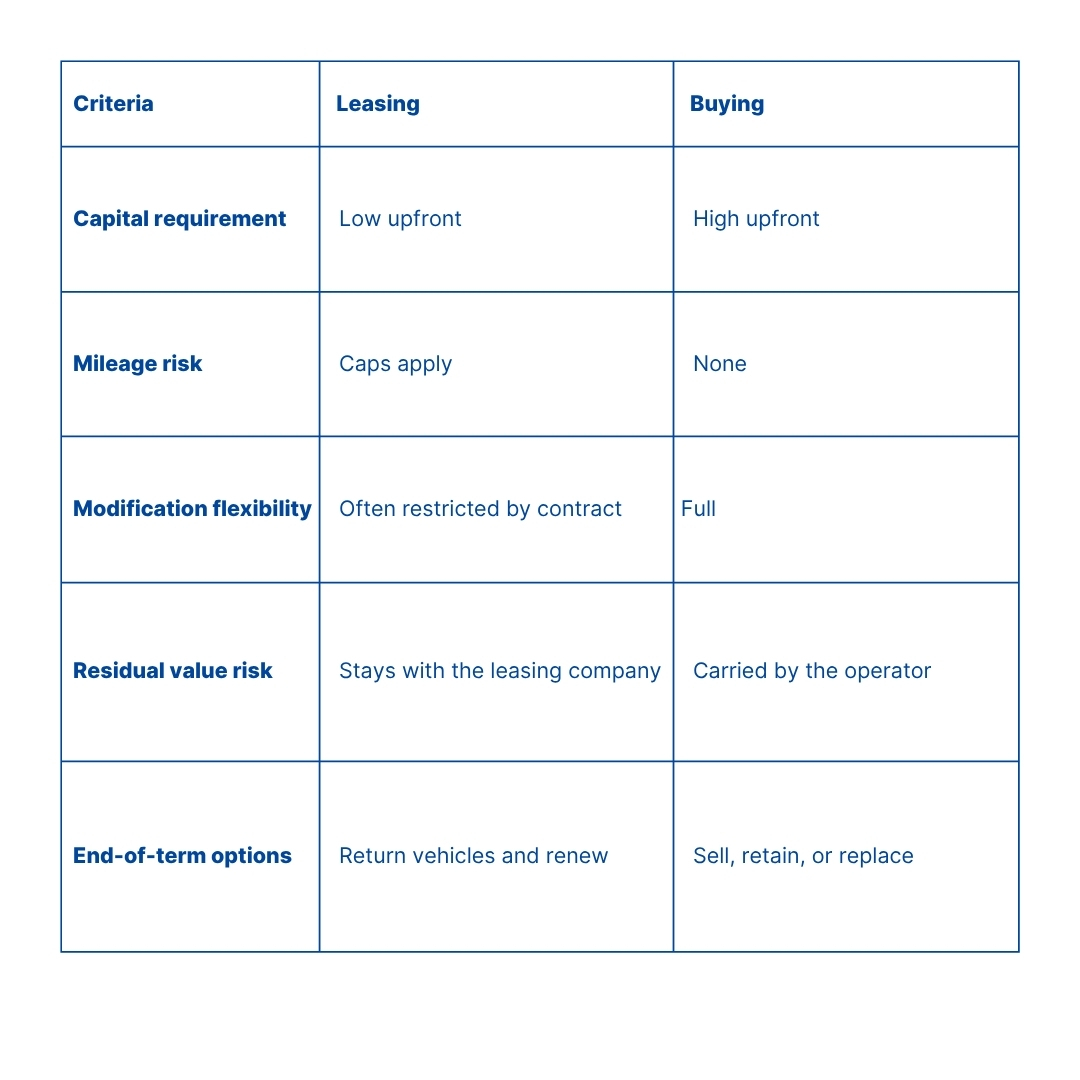
Most operators lease rather than buy, particularly at launch. Leasing preserves capital, keeps your fleet newer without large one-time expenditures, and limits your exposure to residual value risk. In the early stages, when you are still validating demand and refining operations, that flexibility matters.
Ownership becomes more attractive at scale. Once unit economics are proven and demand is stable, buying vehicles can lower your per-unit cost over time. As your business grows, you can eventually set up your own vehicle remarketing team that primarily works to optimize your resales. This way, you also gain full control over how you modify, use, or eventually sell the assets.
Here's a full comparison:
The decision becomes more complex for electric vehicles. EV residual values are harder to predict and have declined significantly in some markets. An operator who owns EVs carries that depreciation risk directly on the balance sheet. Leasing shifts a portion of it to the lessor, which is why many operators prefer to lease EVs even when they buy combustion vehicles outright.
Another option worth considering is a buyback agreement with an OEM. You negotiate to use vehicles for a fixed period before the OEM repurchases them at a pre-agreed price which eliminates residual value risk and offers strong cost predictability. The trade-offs are similar to leasing: mileage caps typically apply, and modifications to the vehicle may be restricted or require explicit OEM approval. This can make installation of a telematics unit more complex.
Mixed Fleets
Starting with a single vehicle model simplifies everything from procurement, maintenance, spare parts to driver onboarding. Standardizing on one model early reduces operational complexity at a stage when you have little margin for it.
As a service matures, diversification becomes practical. Vans serve a different customer entirely: movers, tradespeople, and businesses with cargo needs that a compact car can't meet. Adding a small van category to a car-based fleet can generate additional revenue without replacing the core operation.
Each model you add brings its own maintenance requirements, spare parts, and telematics configuration. Expansion works best when it responds to proven demand rather than anticipated demand. You may even observe what your competitors are doing. If a vehicle category is consistently performing well across other operators in your market, that's worth paying attention to. Before committing to a full rollout, run a small pilot first. Deploy a few vehicles, support it with targeted marketing, and measure actual booking behavior.
Source: INVERS Success Story with CarlundCarla.de
EVs: Challenges and Opportunities
Electric vehicles are moving from optional to expected in many car sharing markets. Regulatory pressure in European cities and shifting operator benchmarks are making EV capability a competitive requirement, not just a positioning choice. Already today, municipalities in many places incentivize the use of EVs by tying car sharing permits to the use of non-combustion vehicles.
The operational challenges are significant. Charging infrastructure remains uneven in most cities, and moving vehicles to charging points adds logistics costs that don't exist with combustion engines. For customers to help with this task, charging cards have to be placed in the vehicles. However, this adds the danger of theft, fraud, and increases your operational complexity. Free-floating operators face this most acutely, since vehicles are dispersed and can't be reliably returned to charging points between rentals. Station-based services have more control but require dedicated charging infrastructure at each location from the start.
Higher acquisition costs and unpredictable depreciation add financial complexity. These factors require more careful modeling than combustion vehicles do, but they don't make EVs the wrong choice.
The upside is real. Lower per-kilometer energy costs, access to zero-emission zones, and alignment with municipal requirements are advantages that grow as cities tighten restrictions on combustion vehicles. Operators who build EV capability into their operations early are better positioned as those restrictions increase.
How Many Vehicles Do I Need?
The right fleet size at launch depends more on your operating model than your market size. Free-floating services depend on vehicle density where users expect to find a car within minutes. This requires a high concentration of vehicles across a defined zone. Station-based services can launch with far fewer vehicles if stations are placed well.
Starting too small is a common risk. A fleet that can't meet early demand creates a poor first impression and makes utilization figures difficult to interpret. Starting too large before operations are stable adds carrying costs before you have the revenue to support them.
A practical approach is to launch with enough vehicles to generate genuine demand, test operations at real scale, and demonstrate unit economics that justify further investment. Growth funded by proven results is more durable than growth based on projections alone.
Source: INVERS Success Story with Wift
Key Takeaways
What makes a vehicle well-suited for car sharing?
Compact size, an established service network, telematics compatibility, and a strong resale market. These factors reduce downtime, lower operating costs, and give you flexibility when it is time to rotate the fleet.
Should I lease or buy my fleet at launch?
Most car sharing operators lease early on. Leasing preserves capital and limits residual value exposure. Buying becomes more attractive at scale, once demand and unit economics are stable and financial commitments carry less risk.
When does a mixed fleet make sense?
When a specific demand is clearly proven. Adding vans to a car-based fleet can open new revenue from movers or tradespeople. Each new vehicle category adds operational complexity, so expand in response to real demand rather than anticipated demand.
Are EVs viable for car sharing fleets today?
Yes, but operational planning is essential. Charging logistics and higher acquisition costs are real constraints. EVs suit station-based services with dedicated infrastructure better than dispersed free-floating fleets, though both models are running them successfully.
How many vehicles do I need to launch?
Station-based services can start small with a few well-placed locations. Free-floating services require much higher vehicle density to generate reliable demand. In both cases, start with enough to prove unit economics before scaling.
Is leasing EVs different from leasing combustion vehicles?
Yes. EV residual values are less predictable and have declined sharply in some markets. Leasing transfers that depreciation risk to the lessor, making it a more attractive acquisition path for EVs than for combustion vehicles.